


If you’ve been around here for a while, you know how much I value a simple, grounded approach to nutrition —and Kelly LeVeque has been one of those guiding voices for years. A nutritionist, author, podcaster, CEO, and fellow boy mom, her philosophy has always just clicked for me. Her Fab Four approach — prioritizing fiber, fat, protein, and greens at every meal — is something I come back to again and again because it’s realistic, sustainable, and actually works in real life.
When she launched her own products, I couldn’t have been more excited to try them out, especially her creatine. Kelly has such high standards when it comes to quality and clean ingredients, so I’ve always trusted anything she creates — if it passes her test, you know it’s good.
Creatine is one of those supplements that’s been having a moment, but it also comes with a lot of confusion, especially for women. So I asked Kelly to break it all down for us — what it is, why it matters, and whether creatine for women is actually worth adding to your routine (spoiler: it is!).
Let’s get into it.

What Is Creatine—and Why Does It Matter?
What exactly is creatine, and what does it do for women?
Creatine is a naturally occurring compound made from three amino acids; arginine, glycine, and methionine. Your body actually produces some on its own, and you get small amounts from red meat and fish, but most of us don’t make or eat enough to fully optimize our stores.
Here’s why it matters: creatine works as a cellular energy battery. It regenerates ATP which is literally your cells’ primary energy source. Think of ATP as the fuel that powers everything from muscle contractions to brain function. When you’re training hard, thinking intensely, or managing sleep deprivation (hello, moms), you’re burning through ATP fast. Creatine replenishes it quickly.
What makes this special for women specifically is that we naturally have 70-80% of the creatine stores men have. That means our baseline tank is emptier which also means we often respond better to supplementation because we have more room to fill up. And the benefits? They go way beyond the gym. Creatine supports cognitive function, mood, energy, muscle strength, recovery, and overall cellular vitality. It’s not just for biceps, it’s for your brain, bones, heart, and every cell that needs reliable energy.
Who Is Creatine For?
Is it just for people lifting heavy weights, or is it important for all women? If you’re not doing major exercise, how much should you take?
Creatine is absolutely not just for lifters. Yes, it enhances strength and muscle performance, but that’s only part of the story. If you’re not training hard, creatine still supports: brain health and cognitive clarity, energy production during daily life, mood regulation, bone density (especially critical postpartum and as we age), and recovery from any physical demand — including sleep deprivation from parenting.
Even if you’re doing yoga, walking, pilates or zero structured exercise, creatine helps your cells function more efficiently. Your body needs energy for everything, and many of us are running on fumes.
Dosing for non-athletes: The standard recommendation is 3-5 grams per day. This is the maintenance dose, and it works beautifully whether you’re hammering a workout or managing a full house. You don’t need more just because you’re not lifting, your cells still need that ATP support.
The beauty of creatine is you don’t have to “earn it” with intense training. A busy mom, a student, someone managing stress, a menopausal woman protecting bone health, all benefit equally.
Thoughts on taking it while pregnant or nursing?
The research is still evolving, but here’s what we know:
Pre-clinical studies (animal models) show protective effects, creatine may help buffer the fetus against low-oxygen events during birth and support fetal brain development.
Creatine naturally appears in breast milk and is part of a nursing infant’s nutrition.
Long-term creatine use in healthy adults is very safe.
There are no human studies showing harm, but there also aren’t large-scale human trials in pregnancy yet.
What the current research suggests: Creatine plays an important role in energy metabolism during pregnancy, especially in the uterus, placenta, and fetal brain. The science is encouraging. But because we don’t have definitive human data, most OBs (rightfully) recommend discussing it with your provider before starting.
My take: If you’re already taking creatine and become pregnant, this is a conversation to have with your doctor. If you’re planning pregnancy, same thing. Some practitioners are starting to recommend it based on the protective research, others prefer to wait for more human data. Your doctor knows your health history best.
For nursing: If you’re taking creatine while breastfeeding, your milk will contain creatine which is fine. But again, check with your provider first.
How to Take Creatine (Without Overcomplicating It)
How much creatine should someone start with, and do you recommend a loading phase or keeping it simple?
I recommend keeping it simple. Here’s why: A loading phase (20g/day for 5-7 days) gets your muscles saturated faster, but it also increases the likelihood of digestive sensitivity and the temporary water shift that freaks people out.
The simple approach:
- Start with 5 grams per day, every single day
- Mix it into water, smoothies, or anything you like (it’s tasteless with Creavitalis)
- Take it anytime—morning for mental clarity, pre-workout for strength, post-workout for recovery, or mid-afternoon for a focus boost
- Your muscles will be fully saturated in 3-4 weeks instead of 3-4 days
- You’ll experience minimal water shift and maximum compliance because it’s easier on your system
Why this matters for women specifically: We tend to be more sensitive to sudden changes in water balance, and we’re more likely to notice and overthink the scale. The gradual approach means you skip the drama and get straight to the benefits.
When is the best time to take creatine, before a workout, after, or does timing not really matter?
Timing is flexible, but here’s how to think about it strategically:
For cognitive benefits: Morning is ideal. Creatine supports mental clarity, focus, and cognitive performance under stress or sleep deprivation. Perfect for busy moms starting their day.
For strength and recovery: Pre-workout or post-workout both work. Creatine boosts your ability to perform hard and recover faster between sets.
For general energy and focus: Mid-afternoon is smart. You get the energy support without stimulating your nervous system like caffeine would.
The real answer: Consistency matters way more than timing. Take it the same time every day so you don’t forget. Your muscles don’t care when they get creatine, they care that they consistently get it.
Pro tip: Take it with carbs and protein (like in a smoothie or with food). This may enhance absorption and can help with any digestive sensitivity.
Seeing the Benefits
How long does it take to start seeing or feeling the benefits of creatine?
This varies, but here’s what to expect:
Immediate (first 1–2 weeks):
- Some people report feeling more energized in their training
- Mental clarity might improve, especially if you’re sleep-deprived
- Mood might lift slightly
By week 3–4:
- Your muscles are becoming saturated
- Strength gains become noticeable during resistance training
- Energy production improves
- Cognitive benefits are clearer
By week 6–8:
- Full muscle saturation is achieved
- You should notice consistent improvements in strength, endurance, recovery, and mental performance
- Any water changes have stabilized
The catch: Creatine works best with what you’re doing. If you’re training hard, you’ll see strength and muscle gains faster. If you’re sedentary but sleep-deprived, you’ll notice cognitive and energy improvements more than physical ones.
Also important: Vegetarians and vegans often see benefits faster because their baseline creatine stores are lower.
Let’s Clear Up the Biggest Myths
A lot of women worry about bloating with creatine — what’s actually normal, and does that go away over time?
Okay, this is the myth I’m most passionate about busting because it stops so many women from trying something that could genuinely change their life.
What actually happens: Creatine is osmotically active, meaning it pulls water into your cells. This is not the same as bloating under your skin (that puffy, soft look). The water goes inside your muscle cells, its intracellular water. This is actually what you want because it: makes muscles look fuller and more toned, can improve performance, and is a sign creatine is doing its job.
Will you see a number on the scale jump? Yes, usually 1-3 pounds in the first week, especially with a loading phase. But that’s water inside muscle tissue, not fat, and not the bloated look most women fear.
Does it go away? It depends on your dose. If you do a loading phase (high 20g dose for a week), some women notice temporary puffiness that resolves in 1-2 weeks as muscles saturate. If you skip loading and just take 5 grams daily, you’ll see minimal water shift because saturation happens gradually over 3-4 weeks. Some women won’t experience any bloating at all. Others might notice a fuller appearance in their muscles. The sensation of stomach bloating is rare at maintenance doses and usually only happens with very high single doses or during the loading phase.
Pro tips to minimize any discomfort:
- Skip the loading phase. Just take 5g daily. You’ll still saturate in a few weeks instead of days.
- Stay hydrated. Counterintuitive but true, dehydration makes your body retain water. Proper hydration helps your body balance fluid naturally.
- Take it with food. This can reduce any digestive sensitivity.
- Always use high quality micronized creatine. The fewer impurities and the more it dissolves, the less discomfort you have.
- Split your dose if you’re sensitive (like 2.5g twice daily instead of 5g once).
Bottom line: The “bloating” fear is largely a misunderstanding of where the water actually goes. And when you see the fuller, more toned look in your muscles? You’ll understand it’s actually a win.
Will creatine make you gain weight or look “bulky”?
This is the second biggest myth regarding creatine for women, and I want to be crystal clear: No.
Here’s the science: Women don’t have the testosterone levels required to build massive, bulky muscles from creatine. Initial weight gain is water in muscle cells which makes you look more toned, not bulky. Long-term weight gain, if it happens, is lean muscle, not fat. Creatine doesn’t add calories, so it can’t directly cause fat gain.
What you’ll actually see: Muscles that look more defined, fuller, and stronger. More tone. Better performance. Not bulk.
Research shows that when women combine creatine with resistance training, they gain lean body mass and actually tend to have lower fat mass compared to placebo. The word “bulk” doesn’t apply—you get stronger, leaner, more capable.
And if you’re not training? You’ll still get all the cognitive and energy benefits without any aesthetic change you don’t want. Creatine isn’t magic that builds muscle on its own—training does. Creatine just makes your cells more efficient so you can perform better during that training.
Beyond the Gym: The Added Benefits
Beyond muscle and strength, are there other benefits of creatine for women—like energy, brain health, or hormones?
Yes, and honestly, this is where creatine gets exciting.
Brain health & cognitive function:
- Improves working memory and information processing speed
- Enhances logical and language-based task performance
- Supports cognitive function during sleep deprivation
- Protects neurons from fatigue
- Supports mood and may help with postpartum mood regulation
Energy & cellular function:
- Regenerates ATP continuously
- Reduces fatigue at the cellular level
- Supports heart health, brain health, and tissues with high energy demands
- Helps you function better on less sleep
Bone health:
- Critical for postmenopausal women protecting bone density
- Helps prevent sarcopenia (age-related muscle loss)
- Works synergistically with resistance training
Hormonal health:
- Supports energy metabolism during hormonal fluctuations
- May support reproductive health
- Works with your body’s natural energy systems
Overall vitality:
- Supports recovery
- Enhances mood and resilience
- Optimizes cellular energy
The bottom line: Creatine is a whole-body tool, not just a muscle tool.
Is It Safe?
Is creatine safe to take long-term?
Yes. Creatine monohydrate is one of the most researched supplements in the world, and long-term safety data is solid.
The evidence: Multiple large-scale reviews show no serious adverse effects in healthy individuals at recommended doses, healthy kidneys are not damaged by long-term creatine use, and long-term studies show excellent safety profiles.
Who should be cautious: anyone with pre-existing kidney disease, liver dysfunction, and anyone on medication should check with their provider.
Best practices:
- Stick to 5 grams daily
- Stay hydrated
- Keep your training and nutrition solid
- Get regular check-ups
- Take it consistently
The reality: Creatine is probably safer than most supplements because it’s so well-studied. It’s not something you need to cycle off—you can take it indefinitely.
What Makes Be Well Creatine Different?
What makes Be Well creatine extra special?
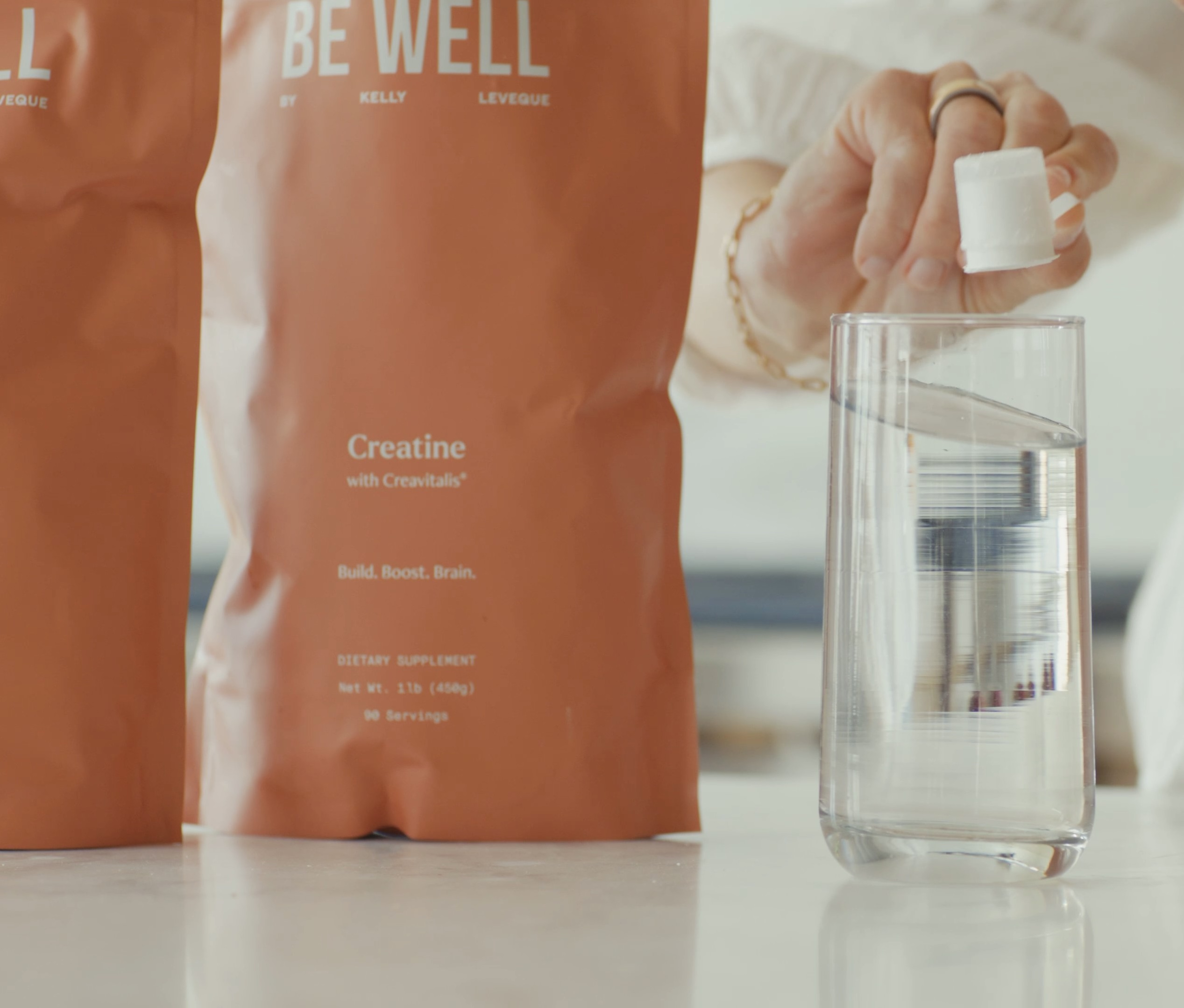
I created Creatine with Creavitalis® because I couldn’t find a product that matched my standards for purity, quality, and real-world benefits.
Here’s what makes it different:
- Uses Creavitalis®, German-made creatine monohydrate
- Micronized for seamless mixing
- Enhanced absorption
- Rigorously tested
- Ultra-pure
The formulation is minimal—one clean ingredient, no fillers, no additives, no unnecessary extras.
Why this matters: You don’t need creatine with 17 extra ingredients. You need pure, high-quality creatine your body can actually use.
How to use it: Mix 1 scoop (about 5g) into water, smoothies, or your Fab Four Smoothie. Take it anytime and stay consistent.
Final Thoughts from Kelly
I’m so glad Lindsay is asking these questions and excited she’s experiencing the benefits herself. Creatine changed my life, both as a functional nutritionist and as a woman navigating full-time work, family, and everything in between. This isn’t hype. It’s science. It’s accessible. And it works. If you take creatine with intention, stay hydrated, keep your training and nutrition dialed in, and be consistent, you’ll unlock benefits far beyond the gym—your brain, your energy, your strength, and your overall capacity to show up as your best self.
Be well,
—Kelly
TLDR (too long, didn’t read): Sum it up for me!
- Creatine helps your body produce energy at the cellular level—so it supports everything from workouts to brain function to overall energy
- Women naturally have lower creatine stores than men, which means we often benefit more from supplementing
- It’s not just for heavy lifting—creatine supports mood, cognition, recovery, and daily energy (even if you’re just doing Pilates, walking, or chasing kids)
- The “bloating” fear is mostly a myth—any initial weight change is water inside muscle cells, not fat or puffiness
- It will not make you bulky—think more strength, better tone, and improved performance You don’t need to overcomplicate it: 5g daily, no loading phase required Timing doesn’t matter as much as consistency—just take it daily and you’re good
- Benefits can start within a few weeks, with full effects around 6–8 weeks
- It supports way more than muscle—think brain health, energy, hormones, and bone density
- Creatine monohydrate is one of the most researched and well-studied supplements out there, with strong safety data for long-term use
Thanks so much for tuning into my Q&A with Kelly—I hope this helped answer your questions and made creatine feel a little less confusing!